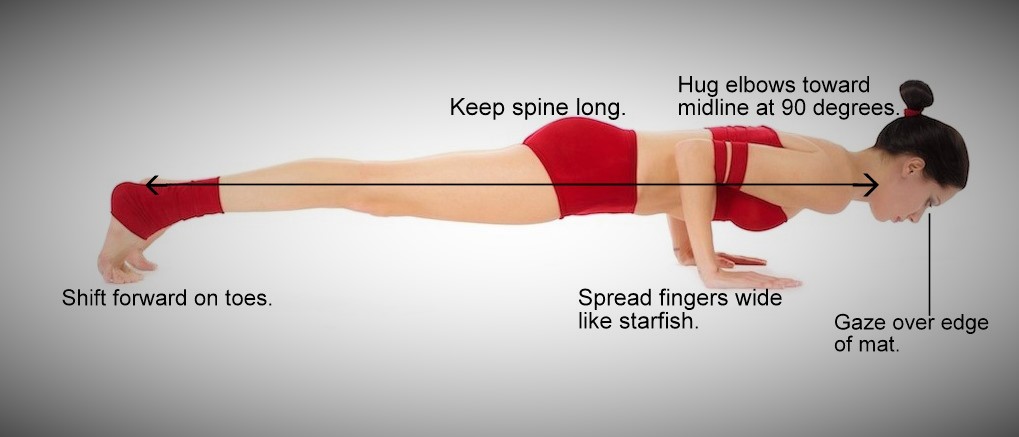
Asana of the Month: Chaturanga Dandasana

Chaturanga Dandasana, translates to Four-Limbed Staff Pose in English, and is often called Crocodile in many Western yoga classes. Chatur = four + anga = limb / Danda = staff + asana = pose.

Yoga is the union of body and mind, so a consistent yoga practice can be beneficial physically and mentally. Physically, Chaturanga helps to strengthen and tone the arms and forearms. It can also help develop flexibility in the wrists. And best of all, it tones the abdominal muscles: six-pack abs of steel–yes please! Mentally, Chaturanga deepens the awareness of body alignment through the arms and midline, and can sharpen your patience.

It is a foundational pose in the Sun Salutations sequence, a staple in most yoga warm-ups. Yogis will hear Chaturanga cued in just about every class, which means you can expect to do it…A LOT. When practicing any movement repeatedly, you must make sure you’re doing it correctly to prevent injury, in this case to the rotator cuffs. Engage those shoulders!

The problem is that Chaturanga is not easy, so many yogis, myself included, are guilty of messy alignment. It’s a challenging pose that requires significant, arm, shoulder, and core strength. If you happen to be weak in any one of those areas, it may seem impossible to gracefully move from High Plank to Chaturanga through to Up Dog and back to Down Dog like you have seen many a practiced yogi do seemingly effortless. There is no comparison in yoga, and you can get there too with a consistent yoga practice. On the plus side, each practice is another opportunity to get stronger, more flexible, and balanced like yin and yang. Yoga practice is a journey with no end goal or perfection in sight.

So what can you do on your journey to a well-executed Chaturanga? First of all, you can work on building your strength with prep poses. Next, you can modify the pose to fit your unique body versus forcing your body to fit some nonexistent ideal. Remember, in yoga the aim is to let go of ego and humbly enjoy where you are in your body in each moment. It’s more important for the pose to feel right than it is for it to look right.

However, just because you can, doesn’t mean you should. Practice satya, or truthfulness, be honest with yourself when considering what is safe for your body, and enjoy the journey. If you are taking care of injuries to the shoulders, wrists or back, avoid the full representation of this pose and practice using one of the modifications provided. Avoid Chaturanga altogether if you have carpal tunnel or a baby on board.

Getting into the Asana
Warm up for Chaturanga with poses to help strengthen and the shoulders, arms and core like Plank Pose, Bhujangasana AKA Cobra, and Urdvha Mukha Svanasana AKA Upward-Facing Dog.

  1. Start in Downward-Facing Dog. Spread fingers wide like starfish, and press into the pads of the palm. Widen the space between the shoulder blades.
  2. Inhaling, shift forward on the balls of the feet into High Plank, bringing the shoulders directly above the wrists and elbows. Activate the legs, internally rotate the thighs, and gently pull them in toward one another. Activate the core adn draw the pubis toward the naval.
  3. Exhaling, bend the arms toward a 90° angle and lower toward the earth for Chaturanga. Hug the elbows toward the midline of the body. Keep the shoulders in line with the elbow without letting them dip any lower. Pull the shoulders back away from your ears, and shine chest forward. Do not lower or lift the chin, and keep the back of the neck long.
  4. Remember to breathe!
  5. To exit
    1. Gently lower all the way down to your belly.
    2. Lower the hips and slide the chest forward for Cobra or Up Dog.
    3. Hold for 10-30 seconds and press back to Down Dog.
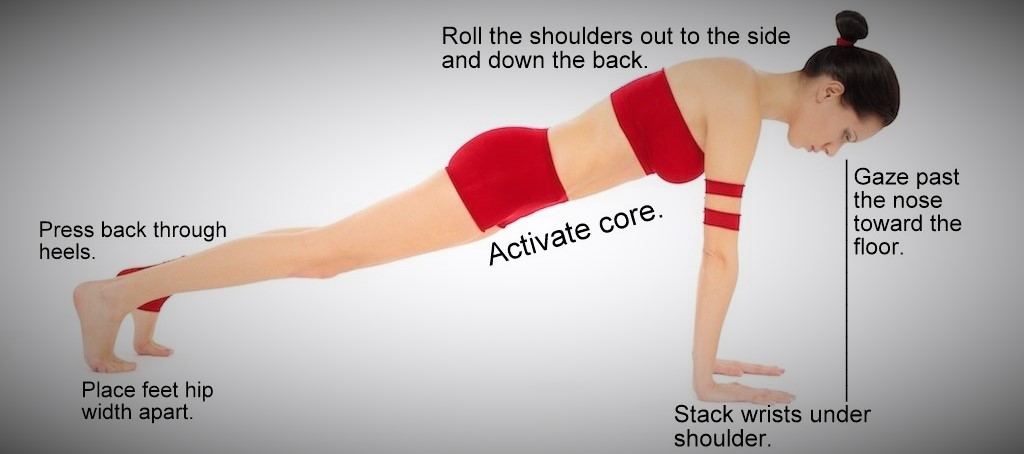
High Plank

Chaturanga Tips

Modifications & Props

  1. If you’re working on increasing strength in the shoulders, arms, or core, go ahead and lower your knees to floor for kneeling Chaturanga.
  2. If you have difficulty with kneeling Chaturanga or you want to get a feel for the correct muscle activation, practice standing with the palms on a wall and moving through the motions.
  3. If your shoulders dip lower than your elbows, wrap a d-ring yoga strap around your arms just above the elbow. The strap keeps you from lowering too close to the floor and help develop muscle memory.
  4. To deepen the pose, lay a rolled blanket or yoga mat on the floor below your Plank Pose parallel to your spine. Lower yourself toward the support and gently hover over it without lying all the way down.
  5. To increase strength, work towards holding the pose for 30, 45, then 60 seconds. Eventually, try adding some yoga pushups, or even attempt it from Three-Legged Dog with one foot of the ground.

Photo Credit

  1. Chaturanga-Dandasana high Yoga-Asana Nina-Mel” by Kennguru is licensed under Creative Commons Attribution CC BY 3.0.
  2. Chaturanga-Dandasana low Yoga-Asana Nina-Mel” by Kennguru is licensed under Creative Commons Attribution CC BY 3.0.


Struggling to find balance, figuratively and literally

A lot has happened the months that have passed since my last blog; I didn’t make one post in October, November, or December, and I was determined not to let January pass me by too.  A quick recap of what I did makes it easy to see that I really was not just lazing around doing nothing for a few months:

  1. I got back into the teaching groove and fall quarter at the college where I work sped by.
  2. I attended a weekend of invigorating yoga training and a separate one day workshop. At both I met some amazing like-minded yogis who remind me that yoga is so widespread and common these days.
  3. I consented to editing a self-published novel for one of my sister’s clients, and I finally finished.
  4. I sewed an awesome costume for Halloween.
  5. I cooked a delectable Thanksgiving feast to share with my family and good friends.
  6. I faced my fear of flying to attend my grandmother’s funeral; the same grandmother that I’ve written about before who I credit with introducing me to the practice of yoga.
  7. I celebrated Christmas with loved ones. I confess that I may have overindulged in consumerism despite making a goal not to succumb to the evils marketing.
  8. I  still  managed to find time to keep up my household chores and spend time with my wonderful family.

With all of that going on, let’s just say I’ve been struggling to find the yogic balance that’s so important for my sanity. I’ve struggled practicing Ahimsa in my own life. I have tortured and overworked myself physically, mentally, and emotionally, and not only am I paying the price, but I find myself on edge with my family and friends so they are paying the price for my actions as well. When I agreed to teach full-time in addition to my part-time gig in the Writing Lab, I had no idea what I was getting myself into. Class preparation for three back-to-back classes the following day takes a lot longer when I’m prepping content for two different levels of English and trying to keep up with grading for eighty students.  It’s my own fault that I’ve once again over committed myself—I really need to practice saying no.

Why is it so difficult for some people to say no? Why do I have such a hard time disappointing the people in my life. It’s not just those close to me either, but I’m afraid of disappointing people I barely know too. Afraid is the key word in that last sentence. It all points to fear. I have a fear of saying no because I am afraid to stare into someone’s eyes when they’re full of disappointment. So am I afraid that I will disappoint them, or am I afraid that I’m not capable of pleasing everyone? It’s a catch-22. If I can’t please everyone around me, then I’m a failure to them; if I stick my neck out to please everyone I’m a failure in my own life.

Fear is often what drives people to do crazy things. Fear of failure keeps well-qualified people from applying for that dream position they fantasized working in while they were still in college. Fear of change and instability makes people stick with jobs they’ve been miserable in for years. Fear of the unknown keeps people grounded in the same small town, or even country for that matter, they were born in. Fear of trying new things is often why people get stuck in ruts. It is all too easy to get comfortable with the same old routine:

  1. wake up at the same time
  2. eat the same breakfast we ate yesterday
  3. motion through our morning rituals
  4. drive the same route to work
  5. eat the same boring sandwich for lunch
  6. drive the same route home in reverse
  7. eat a typical “specialty” for dinner
  8. relax and watch a new episode of an old TV show
  9. lie down the indentation carved into the pillow
  10. drift to sleep in the same comfy position
  11. and repeat day after day

There is nothing wrong with finding comfort in our day-to-day routines, but it can make it difficult to let new, exciting things into our lives. If we don’t try new things, we won’t know what we’re missing. If we don’t make time for those salsa lessons downtown on Wednesday, we’ll never know how good our ballroom dancing skills are. Maybe they are no good, but wouldn’t it be fun to meet some new people, dance into the wee hours of the night together, and find out if we have two left feet? I don’t want to let fear keep me from finding joy.

Self-study, or Svadhyaya, is an important facet of the Yamas and Niyamas of yoga. Getting to know ourselves is challenging, and part of growing as an individual is trying new things. It’s time to let go of fear and take on a new adventure, even if that adventure is trying out a new recipe for dinner or registering for a Spanish class at the community college or saying no when it’s good for your sanity. So what if you find out you don’t like something, at least you learned something new about yourself. Eventually, you might find yourself on that dream vacation digging your toes into the warm sand beneath the shade of a palm tree on a serene beach in Fiji….you gotta embrace that fear of flying first. But hey, you have to crawl before you can walk, you have to walk before you can run, and you have to run before you can jump headfirst into making your dreams a reality.

Free yoga for a better community

Today my practice of Ahimsa involves the courageous path I’m approaching in regards to my yoga “practice” teaching. To complete my yoga teaching certification, I am required to “practice” teach yoga to a group of prospective yogis who wouldn’t normally have the opportunity or the means to practice yoga. I have been discussing with anyone and everyone who will listen my plans to complete eight hours of community service “practice” teaching yoga. With six degrees of separation, you never know who it will be that you talk to that ends up being the “one” who helps you discover the key to unlocking the door to your own success. I’m a firm believer that if you put your feelers out there, you’re bound to grasp a lead. I find myself in a standard catch-22: while I am terrified to “practice” teaching yoga to strangers because I am inexperienced, I have to “practice” teaching someone other than my sister in order to gain the experience necessary to be a successful yoga teacher.   Continue reading

All it takes is a little courage…

… to find balance, self-love, and compassion

This week I am trying to be brave and explore outside of my comfort zone. To take it that extra step further, I’m trying to be excited about my “courageous” choices, but realistically that’s not always feasible. This is part of my month of practicing and observing Ahimsa in my surroundings. So September is my month of nonviolence (well, since I started late in September, I’ll most likely continue with my month of Ahimsa through Halloween).

Today my brave choice was to confront my fear of confrontation. It wasn’t exactly a negative confrontation so I don’t know why I was so afraid. I guess I can kind of be supersensitive and reserved sometimes; honestly I just dislike hurting others (so my month of Ahimsa should be a piece of cake), or perhaps it’s just that I dislike being in uncomfortable situations. But how will I know if I’m hurting someone if I avoid them altogether? Continue reading

What are the Yamas & Niyamas?

The Yamas & Niyamas are like the Ten Commandments of yoga. However, they are not such strict rules that suggest one will be severely punished in the afterlife if they are not followed precisely. Instead, think of them as moral guidelines that, if followed, will lead one on a journey towards contentment. It’s all part of the mind-body-spirit balance that practicing yoga is supposed to help yogis find. Contrary to popular conceptions of what yoga is, it is by no means only about contorting the physical body with goal of kissing your own ass. Yoga incorporates the mind, the body, and the spirit.

Yamas

Ahimsa – Non violence

Satya – Truthfulness

Asteya – Non stealing

Brahmacharya – Nonexcess / Moderation

Aparigraha – Non possessiveness

Niyamas

Saucha – Purity

Santosha  – Contentment

Tapas – Self-Discipline

Svadhyaya – Self-Study

Ishvara Pandidhana – Surrender

By respecting the Yamas & Niyamas and choosing to surrender to a pure, selfless, disciplined life, you can take control of your choices and your path and succumb to the joy of living in the present. What a concept: Live in the moment! Bumper stickers had the answer the whole time.

I am dedicating a month to observing and practicing each of the ten Yamas & Niyamas, so I can scrupulously focus on the concepts of each one and how they connect me to the fabric of the universe. After all, I am but one spark of the divine. This blog is like my journal. Only instead of hiding my secrets inside some dime a dozen diary secured by a flimsy lock and key that’s not fit to protect the adolescent fantasies of a twelve year old girl, I am sharing the jewels of my perception with the regular patrons of cyberspace.

Do Good and Be Good

I’ve never been much into reading what I used to think were dull self-help and spiritual books; I’m fond of a little excitement in my reading, so I’m more of a classics and mysteries kind of gal. Although I don’t attend church every Sunday, I consider myself spiritual and I meditate, or pray if you will, to something divine and dissimilar to God as described in the bible, the Koran, or the Torah of some organized religions. Despite my positive experiences getting picked up and dropped off by the Sunday school bus in Santa Paula, California, and hanging out at Wednesday evening bonfires and playing volleyball on the Ventura beach with the youth group, I hate to admit that I find organized religion kind of scary. So I take a little of this and a dash of that and hold my own simple belief: do good and be good. Continue reading

Hello world!

Well, I’d like to say I’ve been practicing yoga since I was a kid, but that’s only partially true; to be honest, it’s a bit of a stretch. The truth is I remember my grandmother practicing yoga at her Fresno, California apartment in front of her living room television set when I was a fresh three- or four-year-old little girl. I spent a lot of time with Grandma while my mom was working as a welder, a manicurist, an insurance salesperson, or another one of a number of different jobs she experimented with so we could get by. I was mesmerized by the sleek, vibrant colored leotards and graceful figures that my grandma imitated. She encouraged me to follow along too, especially when it was time to do the “sponge”, or what I know now as final relaxation. What a brilliant way to get a rambunctious child to calm down. I remember how limber I must have been and how effortless it was to do the full lotus. That was my first brush with yoga, so in a way I was being honest when I wrote that I’ve been practicing yoga since I was a kid. Continue reading